
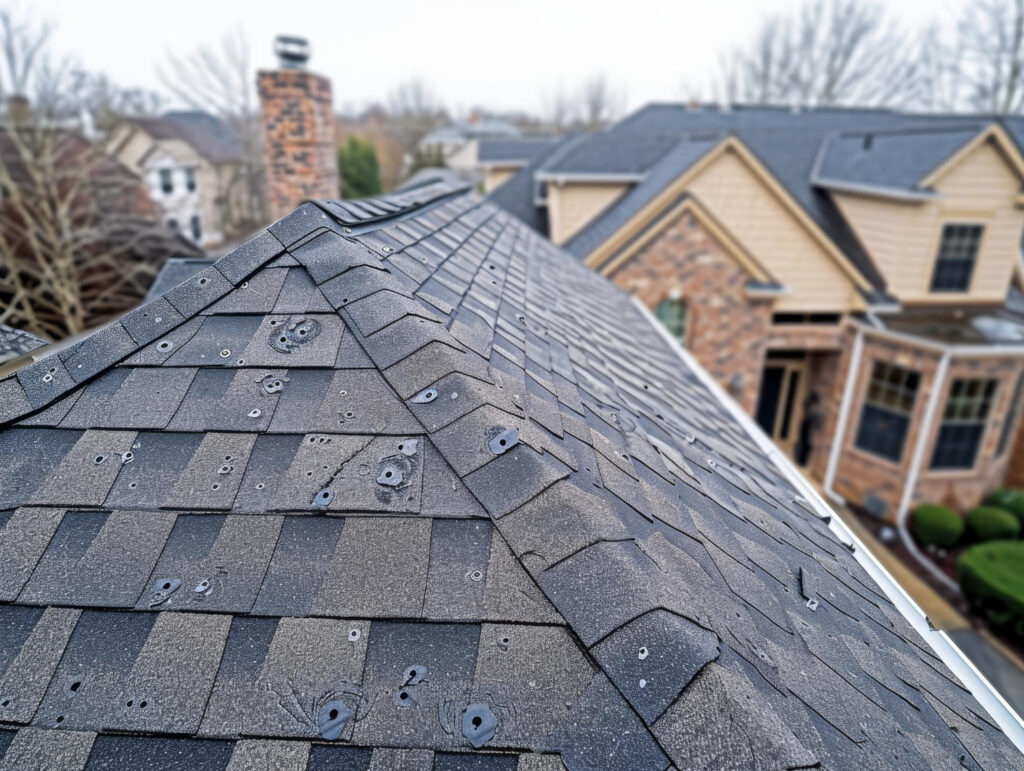
A spring storm rolls through Louisville, and for ten minutes it sounds like gravel hitting the house. The next morning the roof looks fine from the driveway. That is the tricky part about a hail damage roof: most of the damage is hard to see from the ground.
Here is the short answer. Hail damage on shingles usually shows up as soft dark bruises, bare spots where the gritty coating has been knocked off, and cracks. On metal parts like vents and gutters, it shows up as dents. If you had hail around the size of a quarter or bigger, have the roof checked within a few days, and stay off the roof yourself.
Below, we walk through what to look for, what is easy to mistake for hail, and what to do next.
What Hail Damage Looks Like on a Roof
Hail damage looks different depending on what your roof is made of. Asphalt shingles are the most common roof on houses, so start there.
On Asphalt Shingles
- Soft, dark bruises. Press a hit spot with your thumb. A fresh hail hit often feels soft, like a bruise on an apple. The shingle underneath has been crushed even if the top looks whole.
- Missing granules. Granules are the sand-like coating on top of every shingle. They block the sun and protect the asphalt below. Hail knocks them off in round spots, leaving dark circles. After a storm, you may also find piles of granules at the bottom of your downspouts.
- Cracks and splits. Big hail can crack a shingle straight through, often in a curved or star-shaped pattern.
- Exposed mat. The mat is the fiberglass layer inside the shingle. If you can see a shiny or fabric-like layer through a hit spot, water can get in there.
On Metal Roofs
Metal roofs usually show hail as dents. Many dents are cosmetic, meaning they look bad but don’t let water in. Damage becomes a real problem when a dent cracks the paint, bends a seam or loosens a screw, because those spots can rust or leak.
On Other Parts of the Roof
Hail rarely hits only the shingles. These soft metal parts are often the easiest place to spot it:
| Where to look | What you’ll see | Why it matters |
| Roof vents and caps | Dents on the top and sides | A sign hail was big enough to hit shingles hard too |
| Flashing | Dents or bent edges | Flashing is the metal that seals the joints around chimneys, walls and skylights. Bent flashing can leak. |
| Gutters and downspouts | Dents, dings and piles of granules | Easy to see from the ground |
| Skylights | Cracks in the glass or dome, dented frames | Cracks let water in right away |
Hail often comes with strong wind. If you also see lifted or missing shingles, check for other storm damage like water stains inside the house.
Damage That Looks Like Hail but Isn’t
Not every spot on an older roof came from the last storm. Insurers and inspectors look closely at this, so it helps to know the difference.
| What you see | What it probably is | How it differs from hail |
| Small round pits with raised edges | Blistering from heat or trapped moisture | Blisters push up from inside the shingle. Hail pushes down and leaves a soft dent. |
| Thin, even granule loss all over | Normal aging | Hail leaves separate round spots, not an even worn look across the whole roof. |
| Scrapes in a line or near the edge | Scuffs from foot traffic or installation | Hail hits are scattered at random, not in a path. |
| Dark streaks running down the roof | Algae | Algae is a stain, with no dent and no missing granules. |
| A raised bump in a straight row | A nail pushing up, called a nail pop | It lines up with where nails go, not at random. |
Two more clues point to real hail: the hits are scattered at random, and you see matching dents on gutters, vents or your car from the same day.
How to Check for Hail Damage From the Ground
You don’t need to climb a ladder to find most of the clues. Walking a roof after a storm is risky, and wet or hail-hit shingles can be damaged further by foot traffic. Instead, walk around your home and check:
- Gutters and downspouts for fresh dents and dings
- Downspout outlets for small piles of dark, sand-like granules
- Your AC unit, mailbox and car for new dents
- Siding and window frames for chips, cracks or dents
- Plants and trees for shredded leaves and broken twigs
- Your attic for damp spots or water stains on the roof boards, using a flashlight
Take dated photos of everything before anything gets cleaned up or fixed. If you can, also photograph a few hailstones next to a coin or ruler. Those photos help later with an inspector and your insurance company.
How Big Was the Hail?
Hail size matters a lot. The National Weather Service counts hail of 1 inch (about the size of a quarter) or larger as severe, because that is where significant damage to homes and cars tends to start.
| Hail size | About as big as | What it can mean for your roof |
| 1/4 inch | A pea | Rarely damages a sound roof |
| 3/4 inch | A penny | Can mark older or worn shingles |
| 1 inch | A quarter | Severe hail. Worth getting the roof checked. |
| 1 3/4 inches | A golf ball | Damage to shingles and metal parts is likely |
| 2 1/2 inches and up | A tennis ball or bigger | Can crack shingles and break skylights |
These sizes follow the National Weather Service hail chart. An older roof with worn shingles can be damaged by smaller hail than a new one.
Why Small Hail Damage Still Matters
A roof with hail damage often doesn’t leak right away. That is why many homeowners wait, and why small damage turns into a bigger bill later. Here is what happens over time:
- The sun gets to the asphalt. Once granules are gone, sunlight dries out the bare spot. It turns brittle and starts to crack, often within a few seasons of Louisville summer heat.
- Water finds the weak spots. A bruised shingle has a crushed mat underneath. Rain and melting snow work into it slowly, and the first sign may be a stain on your ceiling months after the storm.
- The roof wears out sooner. A roof that might have had years left can need replacing much earlier once many shingles are bruised.
Think of it like a small chip in your car windshield. It looks harmless today, but each hot day and cold night makes it spread.
Should You Repair or Replace a Hail-Damaged Roof?
It depends on how many shingles were hit, how old the roof is and whether new shingles will match.
How adjusters count damage. Many insurance adjusters mark a test square on each side of the roof. A test square is a 10 by 10 foot area, usually outlined in chalk. They count the hail hits inside it. Each insurance company sets its own number, but somewhere around 8 to 10 hits in a square is a common point where that side of the roof gets replaced instead of patched.
Other things that push the decision one way or the other:
- Damage on just one side. Hail often comes in at an angle, so one slope can be badly hit while the others are fine. A repair or a single-slope replacement may be enough.
- Roof age. On a roof near the end of its life, patching dozens of shingles rarely makes sense.
- Matching shingles. Older shingles fade, and some colors and lines get discontinued. If new shingles won’t match, a bigger section may need replacing so the roof doesn’t look patched.
- Damage to the layers below. If water has already soaked the wood deck under the shingles, repairs get bigger.
A good inspection will tell you which parts can be fixed and whether a full or partial replacement makes more sense for your home.
Hail Damage and Your Insurance Claim
A standard homeowners policy usually covers hail damage to your roof. The details in your own policy decide how much you get back, so pull up your declarations page (the summary page at the front of your policy) and look for these two things:
- A separate wind and hail deductible. Some policies use a percentage of your home’s insured value instead of a flat amount, often somewhere from 1% to 5%. For example, if your home is insured for $250,000 with a 2% wind and hail deductible, you pay the first $5,000 of the repair yourself.
- A cosmetic damage exclusion. This means the insurer only pays for damage that affects how the roof works, not just how it looks. It matters most for metal roofs, where many dents are cosmetic.
A few practical steps before you file a hail damage roof insurance claim:
- Take dated photos of the damage, inside and out, before any repairs.
- If water is coming in, cover the spot with a tarp to stop more damage, and keep the receipt.
- Check your policy for the deadline to report a claim. It varies by insurer.
- Have a roofer inspect first so you know whether the damage is worth a claim.
That last step answers a common question: is it worth claiming hail damage? If the repair costs less than your deductible, a claim pays you nothing. If the roof needs a full replacement, it usually is worth it. Knowing what insurance covers on a roof before the adjuster visits also helps you ask the right questions.
Watch Out for Storm Chasers After a Hailstorm
After a big hailstorm, out-of-town crews often go door to door offering free inspections. Some are honest. Others pressure you to sign fast, do quick work and are gone before the first leak.
Kentucky has a state law aimed at this, KRS 367.620 to 367.628. Under it, a roofing contractor working on an insurance-paid roof job:
- Can’t offer to pay or waive your deductible. If someone says “we’ll cover your deductible,” that is a red flag.
- Can’t negotiate your claim for you. A roofer can give you an estimate and talk with your adjuster after you file, but you (or a licensed public adjuster) handle the claim.
- Can’t damage your roof to make a claim look bigger.
- Can’t ask for money up front on an insurance-paid contract until your cancellation window has passed.
That window is important. If your insurer tells you in writing that all or part of the claim isn’t covered, you can cancel the roofing contract until midnight of the fifth business day after you get that notice (Kentucky law).
Before you sign anything, take a few minutes to confirm you are dealing with a legitimate roofing company: a local address, proof of license and insurance, real reviews and a written estimate.
Hail in Louisville: What to Plan For
Hail is a real part of life around Louisville. A few recent examples from the National Weather Service office in Louisville:
- March 2025: mid-month storms brought many hail reports across the area, including big hail in Goshen, just northeast of Louisville, followed by more large hail a few days later.
- May 2024: golf ball-sized hail fell across several central Kentucky counties.
- June 2023: storms dropped hail about 3 inches wide in French Lick, Indiana, damaging a hotel’s atrium roof.
A few things to keep in mind as a Louisville homeowner:
- Hail falls in patches. One street can get hammered while the next one over is fine. Don’t assume your roof is okay because your neighbor’s is.
- Inspection calendars fill fast. After a big storm, roofers get busy. Call early, even if you only suspect damage.
- Plan for the next roof. If you need a new roof anyway, Class 4 shingles carry the highest impact rating shingles can get. Some insurers offer discounts for impact-resistant roofs, so it is worth asking your agent.
Hail Damage Roof FAQs
How bad does hail damage have to be to replace a roof?
There is no single rule, because each insurer sets its own. Many adjusters count hits inside a 10 by 10 foot test square on each side of the roof, and around 8 to 10 hits is a common point for replacing that side. Roof age and whether new shingles will match also play a part.
Will insurance pay for hail damage to a roof?
Usually, yes. Standard homeowners policies cover hail. What you get back depends on your deductible, any separate wind and hail deductible, and whether your policy excludes cosmetic damage.
Can insurance adjusters tell how old hail damage is?
Often, yes. A fresh hail hit shows bright, newly exposed asphalt. Over months, sun and rain dull that spot to match the rest of the shingle. That is one more reason to get the roof checked soon after a storm, not a year later.
What should you tell an insurance adjuster?
Stick to the facts: the date of the storm, the hail size if you saw it, and your photos. Don’t guess or add to what happened. It also helps to have your roofer there during the adjuster’s visit to point out damage. Kentucky law allows a roofer to talk with the adjuster once you have filed the claim.
How long can you wait to repair hail damage?
Check your policy for the deadline to report a claim. Even if the roof isn’t leaking, it is best to act within weeks, not months. Damaged shingles keep breaking down, and waiting can make it harder to show the storm caused the damage.
Not Sure If Hail Hit Your Roof?
Most hail damage is easy to miss from the driveway and easy to confirm up close. If you saw quarter-sized hail or bigger, found dents on your gutters or noticed granules at your downspouts, the next step is a professional roof inspection.
GoRoofGuys is a licensed and insured roofing contractor serving Louisville and Cincinnati. We’ll check your shingles, vents, flashing and gutters, take photos of anything we find and give you a written report, so you know whether you need a repair, a replacement or nothing at all. Reach out to schedule your free roof inspection.