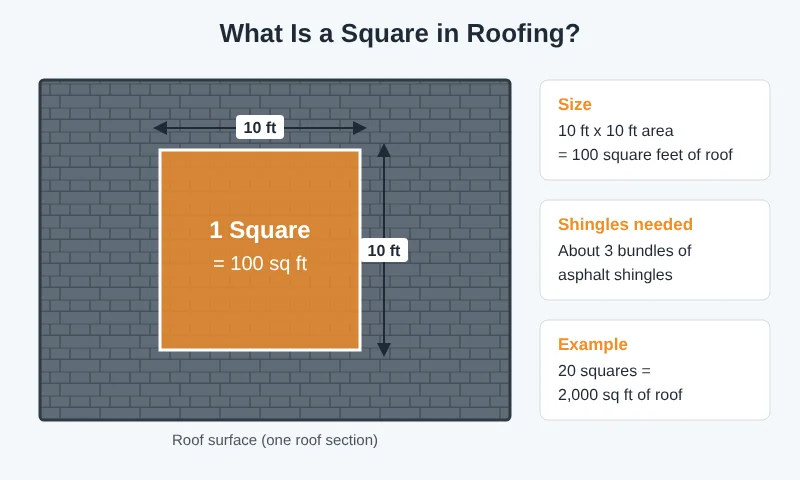
A square in roofing is 100 square feet of roof surface, or an area 10 feet long and 10 feet wide. So when a roofer says your roof is “22 squares,” they mean it covers about 2,200 square feet.
Roofers use this word every day, but most homeowners first hear it when an estimate shows up. Below, we explain what a roofing square is, how to count the squares on your own home, how many bundles of shingles you need and what a square usually costs.
What Is a Square in Roofing?
A roofing square is a shortcut. Instead of writing “2,000 square feet,” a roofer writes “20 squares.” The numbers stay small and easy to compare.
Roofers count in squares because almost everything on a roof is sold and priced that way:
- Shingles are packed so that a set number of bundles covers one square.
- Underlayment is sold in rolls rated by squares. This is the protective sheet that goes over the wooden roof deck, under the shingles, to keep water out.
- Labor is often quoted as a price per square.
One common mix-up: a roofing square is not a square foot, and it is not a square yard either. A square yard is only 9 square feet. A roofing square is 100.
Here is what common square counts look like in real life:
| Squares | Roof surface | Typical home |
|---|---|---|
| 14 squares | 1,400 sq ft | A smaller one-story or ranch-style home |
| 20 squares | 2,000 sq ft | An average single-family home |
| 30 squares | 3,000 sq ft | A larger two-story home or a roof with many sections |
How Many Bundles of Shingles Are in a Square?
A bundle is a wrapped pack of shingles, light enough for one person to carry up a ladder. For most asphalt shingles, 3 bundles cover 1 square.
| Shingle type | Bundles per square | What it is |
|---|---|---|
| 3-tab | 3 | Flat, single-layer shingles with a plain, even look |
| Architectural (also called dimensional) | 3, sometimes 4 | Thicker, layered shingles that give the roof more depth and texture |
| Premium or designer | 4 or more | Heavy shingles made to look like slate or wood shake |
The exact number depends on the brand and product, so always check the bundle wrapper. For example, most popular architectural shingle lines cover about 33 square feet per bundle, which works out to 3 bundles per square.
Bundle count is only one difference between architectural and 3-tab shingles. They also differ in thickness, lifespan and how well they hold up to wind.
How to Calculate Roof Squares for Your Home
You can get a rough count from the ground with a tape measure and a calculator. Here is how:
- Measure the footprint. Measure the length and width of your house from the outside. Add the roof overhang on each side, which is often 1 to 2 feet. Multiply length by width. For an L-shaped home, split it into rectangles and add them together.
- Adjust for pitch. Multiply that number by the pitch factor in the table below.
- Divide by 100. This turns square feet into squares.
- Add waste. Multiply by 1.10 for a simple roof or 1.15 for a roof with lots of angles.
Here is a real example. Say your home’s footprint, with overhangs, is 1,600 square feet and your roof has a 6/12 pitch:
- 1,600 x 1.118 = about 1,790 sq ft of roof surface
- 1,790 ÷ 100 = about 17.9 squares
- 17.9 x 1.10 = about 19.7, so you would plan for 20 squares
- With architectural shingles at 3 bundles per square, that is about 60 bundles
Why Roof Pitch Changes Your Square Count
Pitch is how steep your roof is. Roofers write it as two numbers, like 6/12. That means the roof rises 6 inches for every 12 inches it runs across. A steeper roof has more surface than a flatter one over the same house, so it needs more shingles.
| Pitch | Multiply by | How it looks |
|---|---|---|
| 4/12 | 1.054 | Gentle slope, common on ranch homes |
| 6/12 | 1.118 | Moderate slope, very common |
| 8/12 | 1.202 | Steep |
| 9/12 | 1.250 | Steep |
| 12/12 | 1.414 | Very steep (a 45 degree angle) |
If you are not sure how steep your roof is, check an old roofing estimate or home inspection report. The pitch is usually listed there.
Why Roofers Add 10 to 15% for Waste
No roof uses every shingle perfectly. Some get cut to fit and the leftover pieces are thrown away. Waste goes up when your roof has:
- Valleys: the inside angles where two roof sections meet and rainwater runs down
- Hips: the outside angles where two sloped sections meet along a ridge
- Dormers, chimneys and skylights: shingles have to be cut around each one
- Starter strips and ridge caps: special shingles used along the roof edges and over the peak
A simple gable roof, with two sides meeting at one peak, may only need 10% extra. A roof with many sections and angles can need 15% or more.
How Much Does a Roofing Square Cost?
For an asphalt shingle roof, most homeowners pay roughly $300 to $800 per square installed. That price usually covers materials, labor, tearing off the old roof and cleanup. Basic 3-tab shingles sit at the low end, and architectural shingles, which most homeowners choose today, usually cost about $400 to $800 per square.
| Roofing material | Approximate installed cost per square |
|---|---|
| 3-tab asphalt shingles | $300 to $500 |
| Architectural asphalt shingles | $400 to $800 |
| Metal | $600 to $3,000, depending on the style |
| Clay or concrete tile | $900 to $2,000 or more |
So a 25-square roof with architectural shingles would cost about $10,000 to $20,000. Where your home lands in that range depends on the pitch, how many old layers need to come off and whether any of the wooden roof deck underneath needs repair.
The most reliable way to get your number is a free roof inspection, where the roof is measured and the deck is checked before any price is set.
Why Two Roof Estimates Can Show Different Square Counts
It is common to get two quotes for the same house with different square counts. That does not always mean someone made a mistake. Here is why it happens:
- One roofer adjusted for pitch and the other did not.
- They used different waste amounts, like 10% on one quote and 15% on the other.
- One included the porch roof, garage or dormers, and the other left them out.
- Ridge caps and starter shingles were counted inside the squares on one quote and listed separately on the other.
When you compare quotes, look at both the square count and the price per square. Then ask each roofer how they measured. It is one of the questions to ask before hiring anyone, and a good roofer will gladly walk you through it.
Should You Measure Your Roof Yourself?
Measuring from the ground is fine for a rough idea. Climbing up is a different matter. Many homes, especially two-story houses with steep pitches and dormers, are not safe to walk on without the right gear and training.
Safer ways to get an accurate number:
- Satellite measurement: many roofers measure your roof from aerial images on a computer.
- Drone roof inspection: a drone photographs every section, so the roofer gets exact measurements and can spot damage up close.
- Ask for the report: if a roofer has already measured your roof, ask for a copy.
Knowing about squares also helps after a storm. When spring hail moves through Louisville and you file a claim, the insurance adjuster’s estimate lists your roof in squares. If their count looks low next to your roofer’s measurement, you can ask for a review.
Common Questions About Roofing Squares
What size is 1 square of roofing?
One square of roofing is 100 square feet. That is an area 10 feet by 10 feet.
What does 30 squares mean in roofing?
30 squares means the roof has about 3,000 square feet of surface. With standard asphalt shingles, that is about 90 bundles before adding extra for waste. Roofs this size are usually on larger homes or homes with several roof sections.
What does 14 squares mean in roofing?
14 squares means about 1,400 square feet of roof surface, or about 42 bundles of standard shingles before waste. This is common on smaller one-story homes.
How many bundles of shingles is a square?
Most asphalt shingles take 3 bundles per square. Some heavier architectural shingles take 4, and premium designer shingles can take 4 or more.
How many squares is the average house roof?
Most single-family roofs fall somewhere between about 17 and 30 squares. A 1,700 square foot house often has close to 20 squares of roof, because the overhangs and the slope add extra surface.
Get an Accurate Square Count for Your Roof
Once you know that one square equals 100 square feet, roofing estimates get much easier to read. You can check the math, compare quotes fairly and notice when something looks off.
If you want an exact number for your home, GoRoofGuys offers free roof inspections and written estimates in Louisville and nearby areas. We show you the square count, the pitch, the waste we added and how we measured, so there are no surprises. Every project under our residential roofing services starts with this kind of clear, honest estimate. Give us a call or request your free estimate today.