When homeowners think about their roof, the conversation usually centers on shingles, gutters, or leaks. Roof ventilation rarely makes the list — until something goes wrong. Yet proper roof ventilation is one of the most important factors in how long your roof lasts, how much you pay in heating and cooling costs, and whether your attic quietly develops moisture damage that eventually spreads to the rest of the house. Getting roofing ventilation right from the start — or correcting it when it is inadequate — is one of the highest-value maintenance decisions you can make for your home.
This guide covers exactly how roof ventilation works, why it matters so deeply for both energy performance and structural integrity, how to recognize when it is failing, and which types of roof vents solve the problem most effectively.
How Does Roof Ventilation Work?
Roof ventilation operates on a simple but powerful principle: allow outside air to continuously enter the attic at a low point, flow across the underside of the roof deck picking up heat and moisture, and exit at a high point. This airflow — driven by natural thermal convection, wind pressure, or mechanical assistance — keeps the attic temperature and humidity close to outdoor conditions rather than allowing extreme buildups of either.
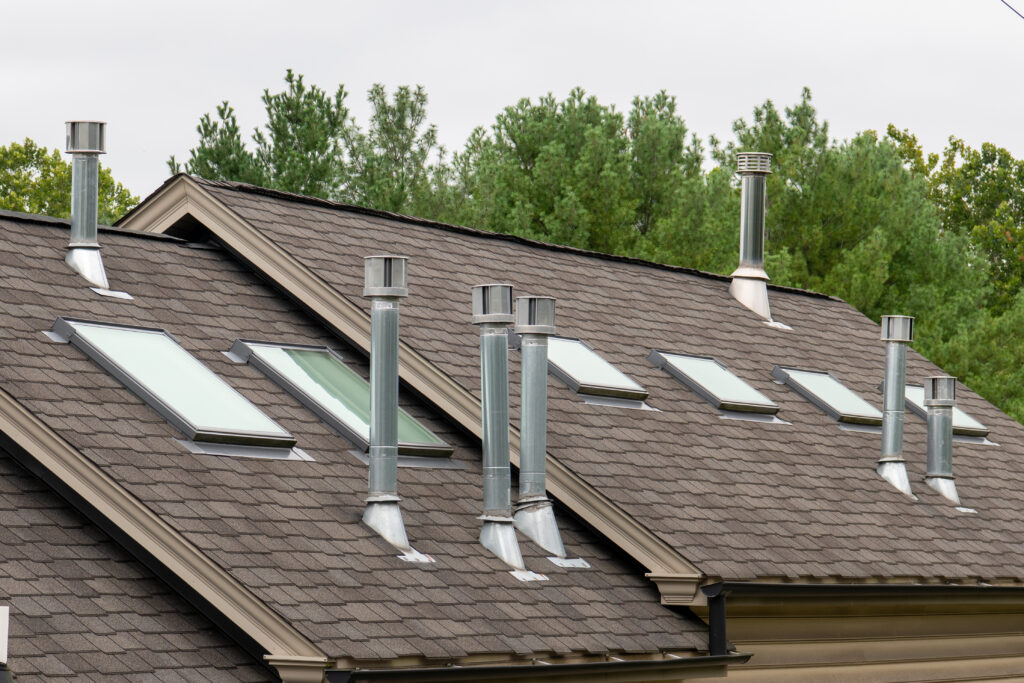
The standard residential roof ventilation setup pairs soffit vents (installed in the eave overhang) with ridge vents (installed along the peak of the roof). Cool outside air enters at the soffits, warms as it moves across the attic floor insulation and roof deck, rises naturally due to temperature differential, and exits through the ridge. This passive system operates around the clock without any moving parts or electricity costs.
Industry standards specify a minimum of 1 square foot of net free vent area for every 150 square feet of attic floor space — or 1 square foot per 300 square feet when a vapor barrier is in place on the attic floor. Balanced systems, where intake capacity roughly equals exhaust capacity, perform best. An imbalanced system — where one significantly exceeds the other — either fails to move enough air or draws air through unintended gaps that can pull conditioned air out of the living space.
Why Is Roof Ventilation Important?
Proper roof ventilation serves your home in three interconnected ways: it extends the lifespan of your roofing materials, controls energy costs year-round, and protects the structural components of your attic from moisture damage. Neglecting it affects all three simultaneously.
It Extends Roof Lifespan
Heat is one of the most destructive forces acting on asphalt shingles. In summer, a poorly ventilated attic can reach temperatures of 150°F or more, even on days when the outdoor temperature is only in the 90s. This sustained, intense heat bakes shingles from the underside — accelerating granule loss, causing premature cracking and curling, and degrading the sealant strips that bond shingles together against wind.
Most major shingle manufacturers explicitly include adequate roof ventilation as a condition of their product warranty. An improperly ventilated attic can void shingle warranties that would otherwise cover workmanship defects, premature aging, and manufacturing failures. Beyond the warranty issue, the roof deck itself — the plywood or OSB sheathing that shingles are nailed to — stays drier and structurally sound for far longer when ventilation prevents moisture accumulation.
It Controls Energy Costs
A hot attic is not just a problem for your roof — it is a direct problem for your energy bill. When attic temperatures spike in summer, that heat radiates down through the ceiling insulation into the living space below. Your air conditioner works harder and longer to compensate, running more cycles and consuming more electricity. Research from the Florida Solar Energy Center and similar institutions consistently shows that proper roof ventilation reduces summer cooling loads by 10–15% in warm climates.
In winter, adequate roofing ventilation also contributes to energy efficiency. Warm, humid air from the living spaces naturally rises and migrates into the attic through electrical boxes, light fixtures, and other small gaps. Without ventilation to exhaust this moist air, it condenses on cold attic surfaces — saturating insulation and reducing its R-value, which makes your heating system less efficient and increases your monthly heating costs progressively over time.
It Prevents Ice Dams and Structural Damage
In cold climates, the moisture and thermal management failures caused by poor roof ventilation take a particularly destructive form: ice dams. When the attic is too warm — typically because heated interior air has entered the attic and is not being exhausted — it melts snow on the upper portions of the roof. That meltwater runs down toward the colder eave overhang and refreezes, creating a growing ridge of ice along the roof edge. As more meltwater accumulates behind the dam, it backs up under the shingles and eventually penetrates into the attic, insulation, walls, and ceilings.
Beyond ice dams, chronic moisture from inadequate roofing ventilation causes wood rot in rafters and sheathing, mold growth on attic surfaces, and degraded insulation performance. These problems are expensive to remediate and can compromise the structural integrity of the roof framing itself if allowed to progress.
Signs of Poor Roof Ventilation
Because the attic is out of daily sight, inadequate roof ventilation often causes damage for months or years before it becomes obvious. These are the warning signs to watch for:
- Ice dams forming along the eaves in winter, or water stains appearing on ceilings near exterior walls after cold spells — classic evidence of ice dam intrusion.
- Attic temperatures that feel extreme compared to outdoor conditions on a warm day — if the attic is noticeably hotter than the exterior air, heat is accumulating rather than being exhausted.
- Visible moisture stains, dark discoloration, mold, or mildew on attic sheathing, rafters, or insulation — evidence of chronic condensation from trapped humid air.
- Shingles curling at the edges, blistering on the surface, or shedding granules at a rate inconsistent with their age — premature shingle aging is one of the most common and costly consequences of inadequate ventilation.
- Energy bills that are higher than expected for your home size and insulation level — an overheated attic increases both cooling and heating loads in ways that are difficult to attribute without an inspection.
- Frost or condensation visible on attic framing, sheathing, or stored items during cold weather — a direct indicator that warm, moist air is entering the attic and not escaping.
If you recognize more than one of these signs, a professional roof ventilation assessment is worth scheduling promptly. In most cases, the fix is relatively straightforward and far less expensive than the structural repairs that follow from letting the problem continue.
Types of Roof Vents
Different attic configurations, roof designs, and climates call for different roof ventilation solutions. Here are the main categories and what each one does best:
Ridge Vents
Installed along the full length of the roof peak, ridge vents are widely considered the gold standard exhaust vent for residential roofing. Hot air naturally rises, so the ridge is the ideal exit point for the warmest air in the attic. Modern ridge vents incorporate baffles that prevent rain, snow, and insects from entering while allowing air to exit freely. They sit low-profile against the roofline and are nearly invisible from the street, which makes them both highly functional and aesthetically clean.
Ridge vents perform best when paired with continuous soffit vents that provide matching intake capacity. The balanced ridge-and-soffit system creates a reliable, passive airflow path across the entire underside of the roof deck from eave to peak.
Soffit Vents
Soffit vents are intake vents installed in the soffit — the finished underside of the roof overhang. They allow cool, dry outside air to enter the attic at the lowest point of the roof assembly. In a properly balanced roof ventilation system, soffit intake capacity matches the exhaust capacity provided by ridge or other exhaust vents.
Continuous soffit venting — a perforated strip running the full length of each eave — provides the most consistent intake across the entire attic. Individual round or rectangular vents are a common alternative but are more prone to partial blockage from insulation and provide less uniform airflow.
Gable Vents
Gable vents are installed in the triangular wall sections at each end of a gable roof. They promote cross-ventilation — wind entering from one gable pushes across the attic and exits the opposite gable. In moderate climates with consistent prevailing winds, gable vents can provide adequate roofing ventilation on their own. However, they are generally considered less reliable than the ridge-and-soffit combination because their effectiveness depends heavily on wind direction and cannot ventilate the attic uniformly along the full roof length.
Powered Attic Ventilators
Electric or solar-powered attic exhaust fans mechanically pull air out of the attic by force rather than relying on natural convection. They are particularly useful for complex roof designs — multi-level roofs, hip roofs, or structures with limited ridge length — where passive systems may not create adequate airflow. The critical requirement for powered ventilators is proper air sealing of the attic floor. Without it, the fan can depressurize the attic enough to draw conditioned air up from the living space, increasing rather than decreasing energy costs.
Turbine Vents
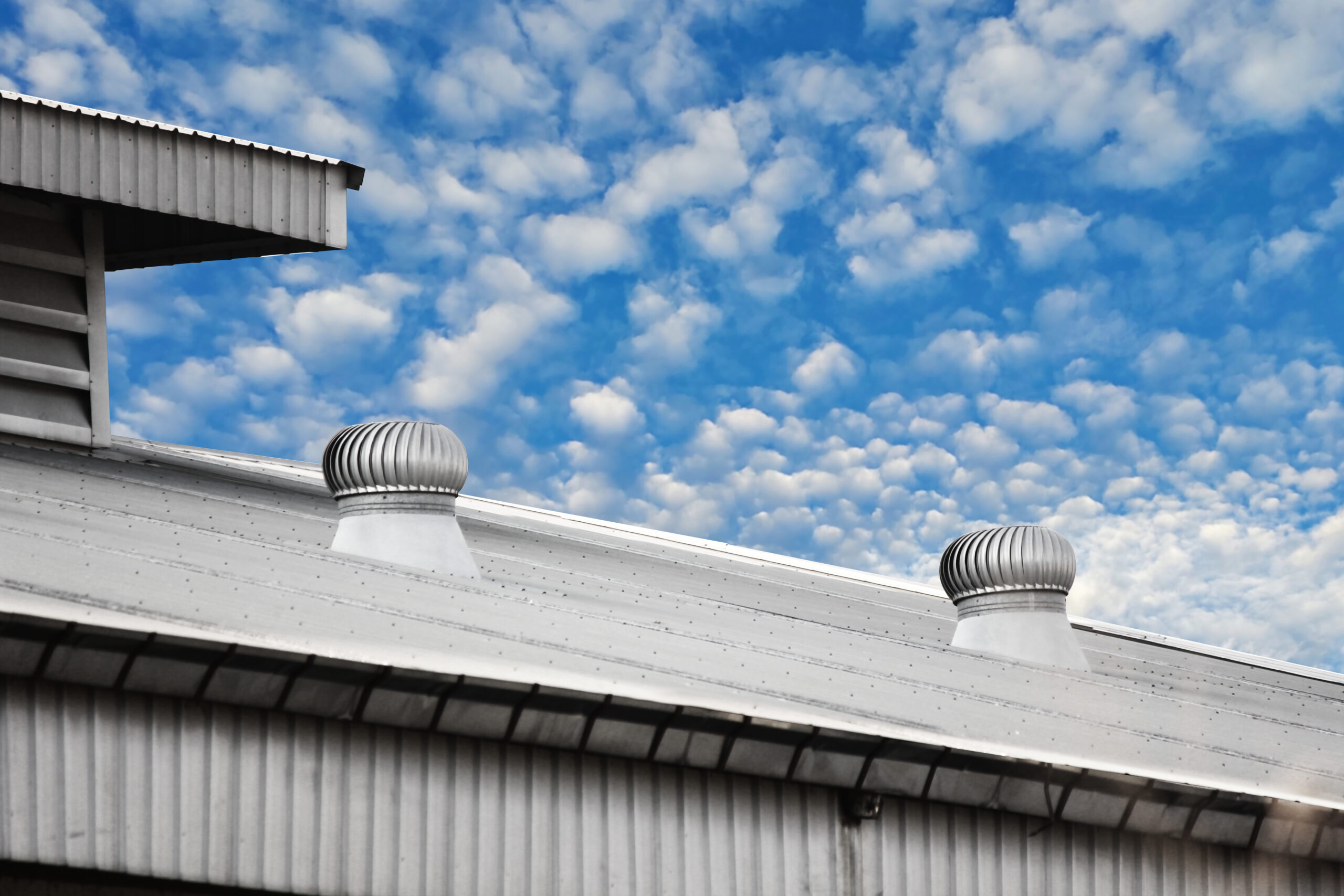
Wind-driven turbine vents use external wind energy to create suction that pulls attic air out through a spinning dome. They require no electricity, can move meaningful volumes of air when wind is available, and are a cost-effective option where passive ridge venting is not practical. Limitations include near-zero performance on calm days and increased noise as bearings wear on older units. Modern turbine vent designs are significantly quieter and more durable than older versions.
Box and Static Vents
Box vents (also called static vents or louvers) are simple openings cut into the upper roof deck and covered with a low-profile hood that sheds rain. They rely entirely on convection and wind pressure to move air. Multiple box vents distributed across the upper portions of the roof can provide adequate exhaust capacity when ridge venting is not feasible. They are inexpensive and durable, but require careful placement to cover the full attic area effectively.
How Much Roof Ventilation Does Your Home Actually Need?
The 1:150 net free vent area ratio is a code minimum, not necessarily an optimal design target. In hot, humid climates, more aggressive ventilation often produces better results. The more important principle is balance: intake and exhaust capacity should be approximately equal. An attic with excessive exhaust relative to intake will draw air through ceiling gaps and other unintended pathways, potentially pulling conditioned air from the living space and reducing the ventilation system’s actual effectiveness.
A roofing professional can calculate your home’s current vent area, compare it to the recommended level for your climate and attic configuration, and identify whether the problem is insufficient intake, insufficient exhaust, or both. In many homes, the fix is as simple as adding soffit vents or a continuous ridge vent during the next roof service — a minor expense relative to the protection it provides.
Conclusion
Roof ventilation is foundational to the performance of your entire roofing system. When done correctly, it operates invisibly in the background — extending shingle life, controlling energy costs, and protecting attic wood from moisture damage for decades. When it is inadequate, the consequences range from higher energy bills and premature roof aging to ice dam damage and structural rot that can cost tens of thousands of dollars to address.
Go Roof Guys provides comprehensive roofing inspections that include ventilation assessment, and we can design and install the right ventilation solution for your home’s specific configuration and climate. If you are not certain whether your home’s roof ventilation is adequate, contact us today — a professional assessment is the fastest way to find out and the best way to protect your investment.